

A bat-eared barnacle with expensive opinions.
Breed Snapshot
Other Names: Frenchie, Bouledogue Français, French Bulldogge
Drool Level: ★★☆☆☆
Expect a damp chin after drinking, meals, or excitement, with more wet face than flying ropes.
Vocal Tendency: Low to moderate. Expect door alerts, attention demands, and the occasional one-bark experiment that worked once and therefore must be repeated forever.
Colors/Pattern Variations: Brindle; Cream; Fawn; White; Brindle & White; Fawn & White; Fawn Brindle; White & Brindle; White & Fawn

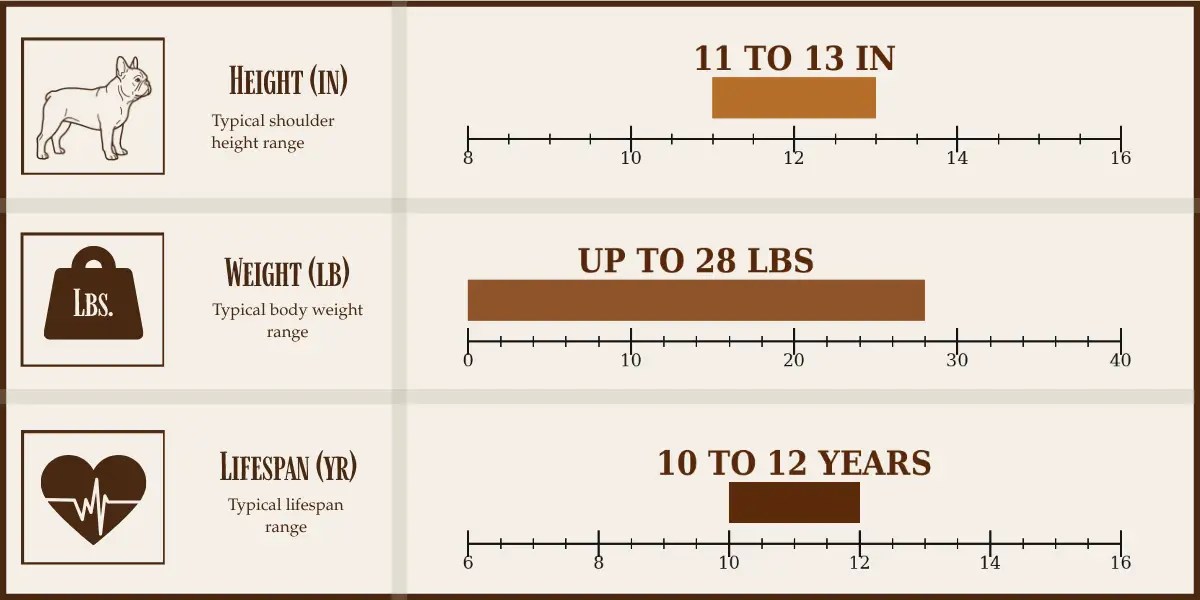
Average Lifespan: 10 to 12 years
General Build: A compact, muscular little brick with a broad square head, upright bat ears, a short tail, and a back that rises slightly toward the rear.
Male Size: 11 to 13 in; under 28 lbs
Female Size: 11 to 13 in; under 28 lbs
Historical Purpose & Working Traits
The original job was company, not a job site.
Its ancestors included small bull-type companion dogs carried from England to France with lace workers in the nineteenth century. French fanciers developed the compact companion type, and American enthusiasts later drew a hard line around the upright bat ear because humans will apparently organize entire clubs around ear cartilage.
Popular breed histories add various small-dog crosses, ratting work, and tidy little origin stories that sound excellent beside an old photograph. The exact recipe isn’t documented well enough to present every version as fact.
What matters is the job that survived.
This breed was selected to stay close, fit into busy homes, and pay attention to people. It wasn’t built for distance, endurance, or independent field work.
The dog still clocks in.

Core Personality, Social Nature & Maturity
A Frenchie doesn’t merely live in the house. It inserts itself into the house.
Bathroom trips, laundry, phone calls, opening a drawer that has never contained food: all apparently require supervision. Most are affectionate, playful, people-focused, and extremely aware of where their humans are.
Some greet strangers like delayed party guests. Others watch first and decide later. What they usually aren’t is emotionally distant.
Their bodies tend to look finished before their judgment catches up. Adolescence can bring louder demands, bigger opinions, selective hearing, and the discovery that furniture height is merely a suggestion.
The adult personality is often funny, social, and stubborn in highly specific ways. Some are busy little shadows. Some are professional loungers. Most are very good at arranging the household around themselves before the household notices.
Modern Ownership Reality & Owner Fit
The apartment-comedian sales pitch is tiny dog, short walk, soft blanket, and somebody willing to admire the ears.
Companion selection made people the center of the job, so modern life often means a dog that wants to be involved in every routine and gets very good at exploiting whatever the household rewards. Small size changes the logistics, but it doesn’t remove the need for manners, independence, and predictable structure.
The right owner genuinely wants close company and is realistic about the hands-on care and cost that can come with the body. The wrong owner thinks small, funny, and low-mileage means cheap, easy, or self-managing.

Children & Family Compatibility
Frenchies can be very good family dogs, especially with children old enough to understand that a dog isn’t a stuffed animal with a pulse.
They’re compact, affectionate, playful, and usually sturdy enough for ordinary family life. They’re also dense little bulldogs with exposed eyes, vulnerable backs, and no interest in being dropped, squeezed, ridden, or carried by a child whose grip is mostly optimism.
Toddlers are the harder match. Fast hands, loud bodies, floor food, interrupted sleep, and enthusiastic hugging create plenty of ways for everyone to make a bad decision at once.
Supervise the interaction. Give the dog a place the child can’t follow. Teach children to leave food, sleep, and sore bodies alone.
“Good with kids” isn’t a waiver for adult judgment.
Dog Compatibility & Conflict Risk
Many Frenchies live happily with other dogs.
The easiest match is a dog that can play without turning every interaction into a demolition derby and can stop when the Frenchie needs space or a break. Familiar dogs often get the warm, playful version. Unfamiliar dogs are less predictable.
Some Frenchies are socially easy. Some bark, posture, guard access to a person, or object loudly when another dog ignores a boundary.
Watch the dog, not the reputation. Interrupt rough play before judgment falls apart. Feed separately when needed, protect rest, and don’t force friendship because both dogs fit in the same photograph.
A cheerful face isn’t universal dog diplomacy.
Cat Compatibility & Prey Risk
A Frenchie can live with a cat, but the cat shouldn’t have to earn peace by moving to the top shelf.
The best odds come with early exposure, a confident cat, protected food and litter areas, vertical escape routes, and a dog that can disengage. Companion history doesn’t certify an individual dog as cat-safe.
Watch what actually happens. Staring, stalking, repeated chasing, cornering, body slamming, or guarding a person from the cat needs management.
Coexistence means both animals can use the house.
Not just the ceiling.
Small Animal Compatibility & Prey Risk
Companion history doesn’t make direct access to tiny pets safe.
One pounce, grab, or burst of rough curiosity can do serious damage even without a strong specialist-prey history.
Use secure physical separation rather than turning a smaller animal into the experiment.

Coat Type, Shedding & Climate Tolerance
The coat is short, smooth, and remarkably good at weaving itself into clothing that appeared clean five minutes earlier.
Shedding is usually steady, with heavier periods as the coat changes. No haircut is required. No, that doesn’t make the whole dog wash-and-wear.
The short coat offers little help in cold weather. Heat is the bigger problem. Frenchies don’t have much room for error on hot, humid days, so summer activity belongs in the cool parts of the day and indoor climate control matters.
Easy coat.
Complicated body.
Grooming Needs & Maintenance
Brush once a week, bathe when dirty, keep nails short, brush the teeth, and check the ears, eyes, facial folds, feet, and the area under the tail.
The coat is easy. The creases are where the paperwork starts.
Folds need to be clean and completely dry. Some dogs have a tail pocket that collects moisture and debris like it was designed by a committee hostile to airflow. Redness, odor, discharge, soreness, recurring ear trouble, or a dog rubbing its face isn’t a cue to buy a stronger wipe. It’s a cue to call the veterinarian.
There’s no haircut to maintain.
There’s still plenty of maintenance.
Training Approach, Priorities & Common Mistakes
Frenchies learn. They also notice very quickly when nobody follows through.
Keep sessions short, clear, and worth their time. Food, play, praise, access, and attention all work, depending on the dog. Endless repetition tends to produce a Frenchie staring at you as though the meeting could have been an email.
Prioritize housetraining, recall, leash manners, drop it, leave it, waiting at doors, settling, being alone, and cooperative handling. The boring skills are the ones that keep a small dog from running the entire house by technicality.
Don’t solve every refusal by picking the dog up. Don’t turn stubborn moments into physical arguments. Pain, heat, fatigue, breathing trouble, confusion, and low motivation can all look like “not listening.”
Train the dog while the problem is still cute.
Cute problems grow habits.

Exercise Needs
Frenchies aren’t ornaments, and healthy ones often want more activity than the lazy-lapdog story allows.
Think several short walks, sniffing, indoor play, food searches, and brief training games rather than one heroic march in bad weather. They need movement and novelty. They don’t need to prove they can jog beside a bicycle while their airway files a formal complaint.
Heat, humidity, body condition, age, spine, joints, and breathing determine what is safe. Stop while the dog is still moving well and recovering normally. Don’t wait for staggering, collapse, or panic breathing to announce that the plan was stupid.
Keep jumping and repeated hard landings sensible. Supervise around water and use flotation for planned exposure.
Fit matters.
Endurance cosplay doesn’t.
Containment & Boundary Management
Most Frenchies aren’t plotting a six-foot-fence escape. They’re still perfectly capable of slipping through a gate, following a person, charging after something interesting, or wandering into traffic while everyone discusses how they “never do that.”
Use a secure fence, working gates, leash routines, doorway manners, and restraint in the car. Their size also makes theft a real concern. A Frenchie left unattended in a front yard isn’t enjoying freedom. It’s being advertised.
Pools and open water need a hard barrier. Many Frenchies are front-heavy, short-muzzled, and poor swimmers. A life jacket is backup, not permission to leave the dog alone.
Containment is ordinary.
The margin for error isn’t.

Health Watch
The notable conditions below are why breathing noise, poor heat tolerance, eye changes, skin trouble, spinal pain, or a sudden drop in normal activity should never be written off as “just a Frenchie thing.”
Use the list as a map for breeder questions, insurance planning, and the changes that deserve early veterinary attention.
- Brachycephalic Obstructive Airway Syndrome (BOAS)
- Atopic Dermatitis
- Intervertebral Disc Disease (IVDD)
- Hemivertebrae
- Corneal Ulceration
- Patellar Luxation
- Canine Hip Dysplasia
- Entropion
- Congenital Heart Disease
- Granulomatous Colitis
Verify and Learn More About the French Bulldog
- French Bull Dog Club of America – Official breed club info, history, and breeder education.
- French Bulldog AKC Breed Profile – General overview, temperament notes, and basic care guidance.
- VCA Hospitals – French Bulldog Breed Profile – Vet-reviewed breed overview covering health tendencies, care needs, and day-to-day management from a clinical, owner-friendly perspective.
Zero Woofs Reality Check
A French Bulldog is a people-centered companion whose charm comes attached to real limits in heat, exercise, breathing, grooming, and medical margin. Does that hands-on level of care fit your CURRENT life, or would another breed be the kinder match?
Take the Dog Breed Compatibility Quiz to find a dog that actually fits your lifestyle (instead of your ego).
If you want the brutal truth about hundreds of breeds before you make a questionable life choice, grab Woof-a-Pedia: The Brutally Honest Dog Breed Guide from the ZWG shop.